

Measuring Cable Length Using an Oscilloscope and Signal Generator
In this article, we’ll look at the basics of measuring the length of a cable using an oscilloscope and a signal generator. You may ask yourself, why on earth would you need to do this? The short answer is you wouldn’t. So why go through the exercise? It’s one of those exercises that can be useful in understanding what is going on conceptually in a commercial time domain reflectometer (TDR). In this article, we are going to limit the scope of the discussion to determining cable length. We’ll come back to the other types of measurements the TDR performs, specifically return loss and VSWR if there is interest.
A Basic Example
Technically my signal generator can not generate a pulse with a fast enough leading edge to resolve short cable lengths, and my oscilloscope is software crippled at 100 MHz. To compensate for these shortcomings I decided to test a cable that was 25 ft in length plus a secondary 9 ft jumper. My prediction is that we can expect to see a fair bit of error in the measurement. By a fair bit… I mean a foot or two.
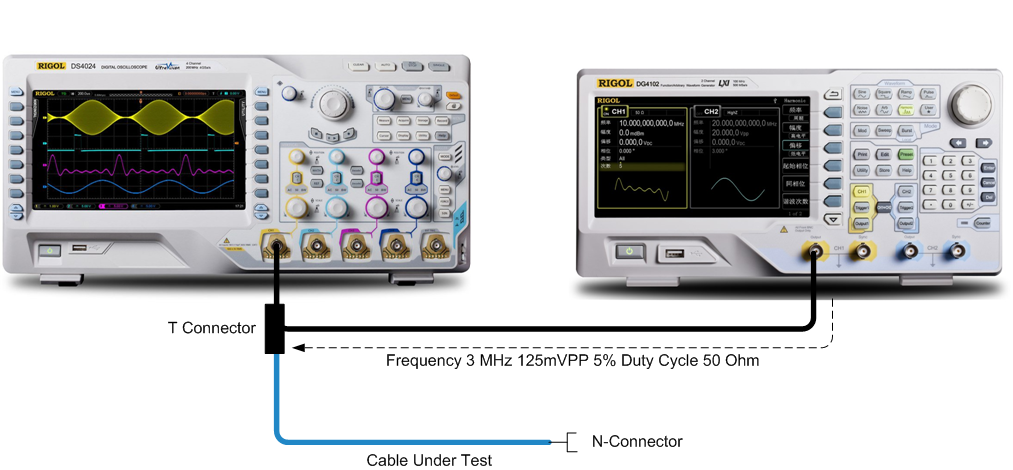
The test setup is shown below. A signal generator on the right and an oscilloscope on the left. I set the signal generator to pulse mode, used a frequency of 3 MHz and a signal amplitude of 125mV peak to peak. Note the frequency and amplitude are not critical. The duty cycle of the pulse was set to the minimum permitted by the signal generator, approximately 5 percent. I also set the impedance of the signal generator and the oscilloscope to 50-ohms.
Turns out I was wrong. The measurement error with the setup above was less than a foot. How much less…. not really sure. The error in physically measuring the cable with a tape measure likely had an error of at least plus/minus 2 inches.
The Results
The plot to the below shows the launch pulse into the cable and jumper. The cable under test is terminated with a 50-ohm load.

If you’re not familiar with an oscilloscope, it simply measures the voltage over time. The y-axis is the amplitude or voltage, and the x-axis is time. The graticules (light gray dotted lines) provide a reference. In this case, the height (amplitude) of the graticule is 200 mV and the width (time) of each gradual is 20 nS.

The plot to the left shows the same launch pulse into the cable under test (peak on the left). The end of the cable has been left open (peak to the right). The difference between the two peaks is 99.2 nS. A third inverted reflection (not labeled) can be seen on the far right of the screenshot.
The third plot to the right shows the same launch pulse into the 50-ohm cable. In this measurement, the cable under test was shorted to ground at the far end connector. The reflection is now shown inverted but the time difference is still 99.2 nS.

The Math
Even though the setup is crude, we can still determine the cable length using the data collected above. We know that the cable type is RG-142 and that the velocity of propagation from the datasheet is 70%. We also know that propagation in free space is 1 nS/ft.
With this information we can calculate the cable length:
Length in feet = ((Propagation In Free Space*Velocity of Propagation) * (Time between launch and reflection))/2
= ((1 * 0.7) * 99.2) /2
=  34 ft.
And in fact, the cable was 25 ft in length plus a jumper of 9 ft, for a total of 34 ft.
In case you’re wondering why we have to divide by two. The 99.2 nS is the total round trip delay, from the launch to the end of the cable and back to the source.
Can We Do Better
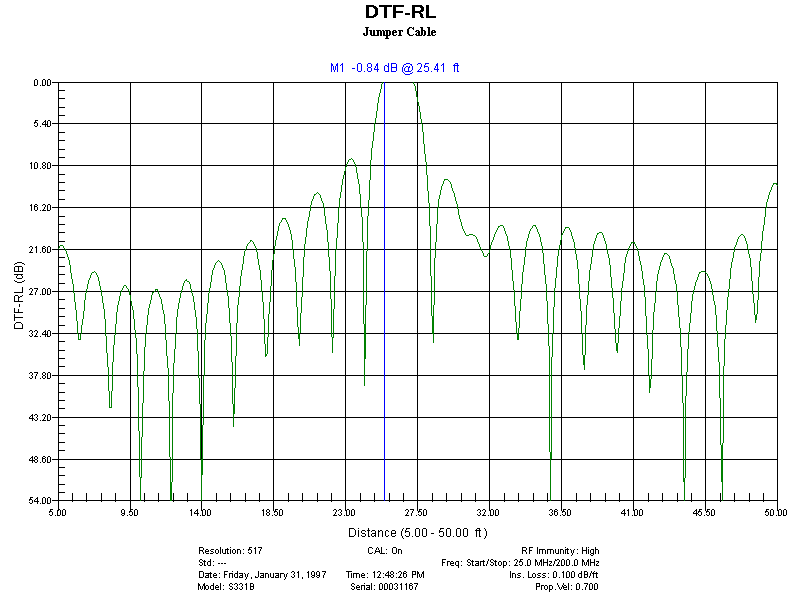
The short answer is yes! This is where commercial TDR equipment shines. TDR’s automates the measurements, hides the complexity, speeds up the measurements, provides consistent results, and in general makes life a whole lot easier. Below you’ll find the same measurement using the same RG-142 cable (minus the 9 ft jumper) using a Site Master S331B. If you’re trying to compare the plot below with the plots above, be aware the plot below is showing Return Loss (dB) vs distance (ft) and not voltage vs time. Marker M1 specifies the cable length (25.4 ft) which is spot on.
Conclusion
Whether your network relies on coax, twisted pair, or fibre optics to deliver network services, characterization of that infrastructure is vital. You will be expected to ring every bit of performance from your network. To do that you need to understand the limitations of your infrastructure. This article covers just one aspect of what a TDR does.
TDR’s and OTDR’s are able to accurately measure a cable’s length, locate faults and characterize performance across the services operating frequencies and/or wavelengths. TDR’s do have their limitations, they cannot measure PIM (passive intermodulation), and there are faster, better and less expensive ways of measuring insertion loss, but with the demands of today’s networks we can no longer assume that your network is going to perform at the top of its game without actually measuring it.
That’s it for today. Cheers!